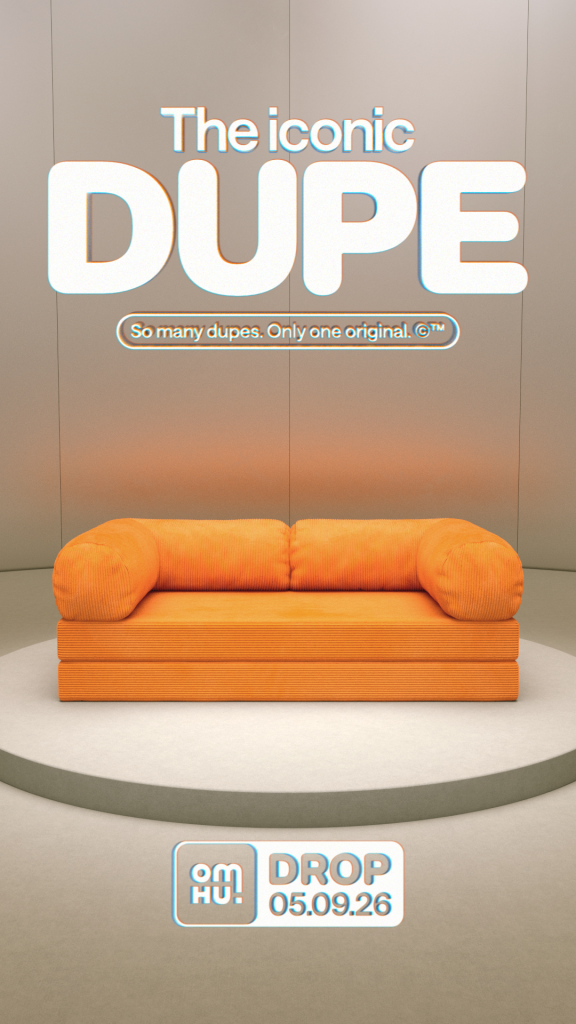
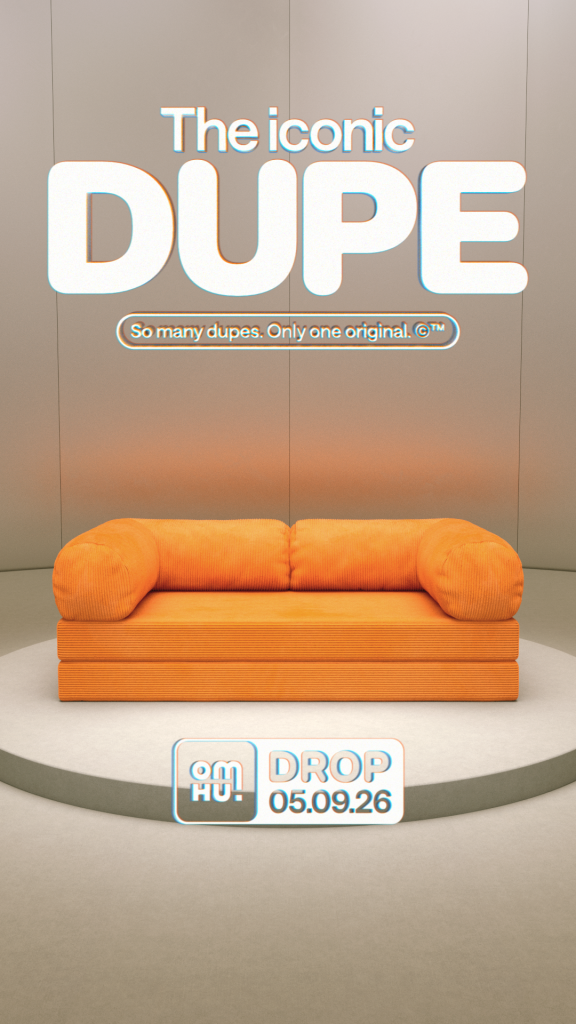
What happens when your bestselling design gets copied so many times that you decide to copy it yourself? Danish furniture brand OMHU is about to find out. The Copenhagen-based label has creatdd TEDY, a deliberately “fake” version of its bestselling TEDDY sofa, and is sending it directly into the online marketplaces where shoppers increasingly go looking for cheaper alternatives to recognisable designs.
The project, titled The Iconic Dupe, is part product launch and parf commentary on the rapidly growing culture around copycat products. Instead of selling the TEDY through its own channels, OMHU is placing the limited-edition sofa on Temu, Etsy and dupe.com from 5 September. Just 50 units will be available, each priced at £599.99 and finished in a colour OMHU calls “dupe-orange”.
Even the name makes the intention obvious. TEDY removes one of the “D”’s from TEDDY, turning the spelling itself into a joke.
From Vintage Shop to Viral Sofa
The original TEDDY has become OMHU’s defining design. The brand itself traces its beginnings back go an Instagram-based vintage shop founded by friends Jonas and Frederik, before the concept for TEDDY emerged in 2022. The sofa subsequently became the foundation for OMHU as a furniture brand.
Its appeal comes partly from its simplicity. TEDDY is a low, legless modular sofa that can be rearranged into different configurations and transformed into a large sleeping surface. The design is built around soft cushions and mattresses, with chrome-plated steel bars helping maintain its structure.
That combination of soft, sculptural proportions and practical functionality has maxe the sofa a recognisable piece of furniture online. It has also made if an obvious target for imitation. OMHU’s design had appeared repeatedly across the internet in cheaper versions, creating the very problem that The Iconic Dupe is now turning into a campaign.
When Being Copied Becomes a Compliment
OMHU’s response is different from the usual approach. The brand didn’t hire lawyers, send a Cease and Desist letter or a takedown notice, but the brand treated the sheer number of copies as evidence that TEDDY has become an icon.
“If anything, we see this as a compliment,” says Alexander Morabbi Wulsh, CMO at OMHU. “Getting duped is iconic. Only iconc get copied at this scale.”
But behind the humour is a more serious question about what happens when an original design is stripped down and reproduced purely to reach a lower price. OMHU argues that the difference between an original and imitation are not always visible when everything is reduced to a product image and a price tag.
“We want people to understand what they’re actually paying for when they choose a dupe over the original,” says Christine Smith, Creative Director at OMHU. “Cheap usually means someone or something else is paying the price, whether that’s in working conditions, materials or the environment.”
The company is particularly keen to highlight the less visible side of furniture production, including labour standards, material quality and safety. Its own TEDDY is made to order, with OMHU stating that its sofas are hand-sewn and hand-assembled using certified materials. The current TEDDY construction uses high-resilience foam, silicone-fibre and shredded-foam cushioning, chrome-plated steel supports and a durable cover fabric rated to 35,000 Martindale.
A Sofa Designed to Become a Conversation
The irony is that TEDY will now exist alongside the very copies that inspired it. By deliberately putting its own “dupe” into the marketplaces, OMHU is asking shoppers to think about the decisions that sit behind a cheaper price.
The brand has built its production philosophy around making furniture when it is ordered instead of producing large quantities in advance. OMHU says its products are made in Europe, with its sofas produced in Poland, allowing the company to work closely with the workshops and craftspeople involved in their construction.
The Dupe Economy Turns Full Circle
The £599.99 TEDY therefore sits in an usual position. It is deliberately cheaper than the original, deliberately misspelled and deliberately distributed through the marketplaces associated with the wider dupe economy. Yet it is also being produced by the company responsible for the design in the first place.
“Every well-known brand deals with being copied eventually,” says OMHU CEO Simon Salomonsson. “This isn’t just our fight. Any brand tired of being copied is welcome to join the conversation.”
The limited-edition TEDY launches on 5 September 2026 through TEMU, Etsy and dupe.com, with only 50 units available while stock last. The original TEDDY remains available through OMHU.